Shmoo
(not
Schmoo) Facts
& Trivia
Cartoonist Al
Capp was already
world-famous and a
millionaire in 1948 when
he in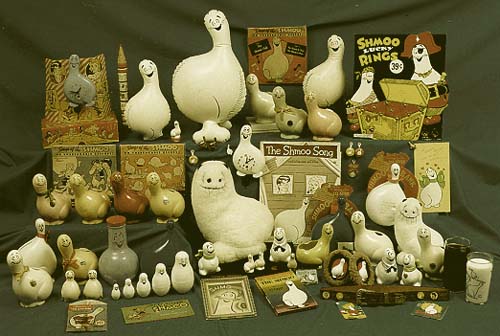 troduced an
armless pear-shaped
character called the Shmoo
into his daily "Li'l
Abner" strip. The
unusual creature loved
humans. A Shmoo laid
eggs and bottles of
Grade A milk in an
instant, and would
gladly die and change
itself into a sizzling steak
if its owner merely looked
at it hungrily. Its skin
was fine leather, its
eyes made perfect
buttons and even its
whiskers made excellent
toothpicks. Shmoos
multiplied much faster
than rabbits, so owning
a pair of Shmoos meant
that any family was
self-sufficient. Of
course the Shmoos proved
too good for
humanity's sake and
therein was the basis
for Capp's ultimate (and
tragic) satire. But a
remarkable phenomenon
occurred during the
telling of his tale.
troduced an
armless pear-shaped
character called the Shmoo
into his daily "Li'l
Abner" strip. The
unusual creature loved
humans. A Shmoo laid
eggs and bottles of
Grade A milk in an
instant, and would
gladly die and change
itself into a sizzling steak
if its owner merely looked
at it hungrily. Its skin
was fine leather, its
eyes made perfect
buttons and even its
whiskers made excellent
toothpicks. Shmoos
multiplied much faster
than rabbits, so owning
a pair of Shmoos meant
that any family was
self-sufficient. Of
course the Shmoos proved
too good for
humanity's sake and
therein was the basis
for Capp's ultimate (and
tragic) satire. But a
remarkable phenomenon
occurred during the
telling of his tale.
Virtually
overnight, -as a LIFE
magazine headline put
it- the "U.S. Becomes
Shmoo-struck!" The
character's remarkable
success catapulted Capp
to an all-new level of
wealth and fame. It is
difficult, fifty years
later, to convey to new
generations the profound
impact the lovable Shmoo
had on American culture.
The following facts may
help.
* * *
• Close
to
one hundred licensed
Shmoo products from
seventy-five different
manufacturers were
produced in less than a
year, some of which sold
five million units
each. (Sources: Newsweek
9-5-49 and Editor
& Publisher
7-16-49)
•
The Shmoo was an
unprecedented media
and merchandise
phenomenon (1948-52).
America went
Shmoo-crazy. There had
never previously been
anything like it.
Comparisons to
contemporary cultural
phenomena are
inevitable. But modern
crazes are almost always
due to massive marketing
campaigns by large media
corporations, and are
generally aimed at the
youth market. The Shmoo
phenomenon arose
immediately,
spontaneously and solely
from cartoonist Al
Capp's daily comic strip
(something that simply
wouldn't happen today)
and it appealed widely
to Americans of all
ages.
• Forty
million people
read the original 1948
Shmoo story (combined
circulation of the 500+
daily newspapers
carrying "Li'l Abner").
And Capp's already
considerable readership
roughly doubled
following the
overwhelming success of
the Shmoo.
• Unprecedented
serious
attention. When
Simon & Shuster
published The Life
& Times of The
Shmoo in 1948, it
was reviewed coast to
coast alongside Dwight
Eisenhower's Crusade
in Europe (the
other big book at that
moment in time). The
S&S Shmoo
collection was the first
cartoon book to achieve
serious literary
attention.
• Simon
& Shuster sold
700,000
copies of its Life
& Times of the
Shmoo in the first
year o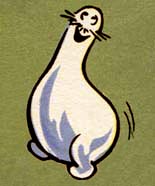 f
publication alone, an
undisputed best seller.
f
publication alone, an
undisputed best seller.
• Berlin
Airlift. Shmoos
were air-dropped to
hungry Berliners by
America's 17th
Military Airport Squadron
during the Soviet
Union's tense blockade
of West Berlin in 1948.
"When the candy-chocked
Shmoos were dropped a
near-riot resulted." –Newsweek
9-5-49 (and 10-11-48).
•
Time cover. The Shmoos
and Capp made the
cover of Time
magazine (11-6-50).
They
also garnered
nearly a full page
(under "Economics") in
the 8-13-48
International section of
Time and
Time's "The Press"
section on 5-23-49.
Similar major articles
ran in Newsweek,
Life, New Republic
and countless other
publications and
newspapers.
• Shmoos
invade the
Presidential election.
During the 1948
Presidential campaign,
Republican challenger Thomas
E.
Dewey accused
incumbent Harry S.
Truman of
"promising everything
including the Shmoo!"
(Reported in Newsweek
9-5-48).
• A Shmoo
Savings
Bond was issued by
the U.S. Treasury
Department in 1949! The
valid document was
colorfully illustrated
with Capp's character,
and promoted by the U.S.
Government with a $16
million dollar
multimedia advertising
budget. Al Capp
accompanied President
Truman at the bond's
unveiling ceremony.
• During
its first year Shmoo
merchandise generated
over $25,000,000 in
sales (in 1948
dollars)!
The Shmoo
continues to garner
attention and prove
collectible more than a
half century after its
debut. In the past two
years alone a book from
Overlook Press has been
published in hard and softcover,
Dark Horse Comics has
produced a new Shmoo
statue, button and
collectible tin.
Articles on the Shmoo
have appeared in Pages
(10-02), Toy Stories
2003 Annual, Salon.com,
newsarama.com and
elsewhere. Russian
"nesting" Shmoos, a soft
vinyl Shmoo, and a
desktop CD featuring
all-new Shmoo animation
are in the works for the
coming year.
-Denis
Kitchen, © 2004